Guide to selling returned goods: what to do with items that come back

Selling Returned Goods: What to Do with Items That Come Back

Table of contents

Selling returned goods sounds like a side issue until the shelf with returned parcels is full. Every item on it is paid for, takes up space and loses value week by week. The question is not whether you do something with it, but which route you choose for which item.

Key takeaways

Why do returned goods so often stay on the shelf?

After the refund a return feels finished. The customer has the money, the ticket is closed. From then on nobody is responsible for the goods themselves.

Then there is the effort: a single item with opened packaging is not worth a listing of its own with new photos and new text. So it goes on the shelf, and next time there is already another one beside it.

Which five options are there for returned goods?

1. Back on sale. If the item is unused and the packaging is fine, it goes back into stock. That is the best case, and it requires that you really check the condition at goods receipt.

2. Back to the supplier. In dropshipping and with consignment goods this is the normal case. What matters is a packing slip, so the supplier can match the shipment, and a list of the cases where the credit note is still outstanding.

3. Sale as B-stock. Opened packaging, slight signs of use: you sell such items at a discount with a clear description. Marketplaces often have their own condition grades for this.

4. Passing on to other merchants. What is no longer worth it for you may fit another merchant’s range. That applies especially to single pieces and small quantities.

5. Refurbish or recycle. Defective goods can sometimes be repaired or used for spare parts. What remains is disposed of properly.

The condition decides the route. If you don’t note it at goods receipt, you decide later from memory.

What matters in a condition note?

A good condition note answers three questions: Has the item been used? Is the original packaging there and undamaged? Are there visible flaws?

Be specific. “Original packaging opened, item as new” helps a buyer more than “good condition”. Photos of the actual item save questions. And if you are honest here, the item does not come back a second time.

How do I sell returned goods to other merchants?

Selling between merchants rarely fails because of the price. It fails because of contact. If you have three pairs of headphones with opened packaging, you usually don’t know a buyer for them.

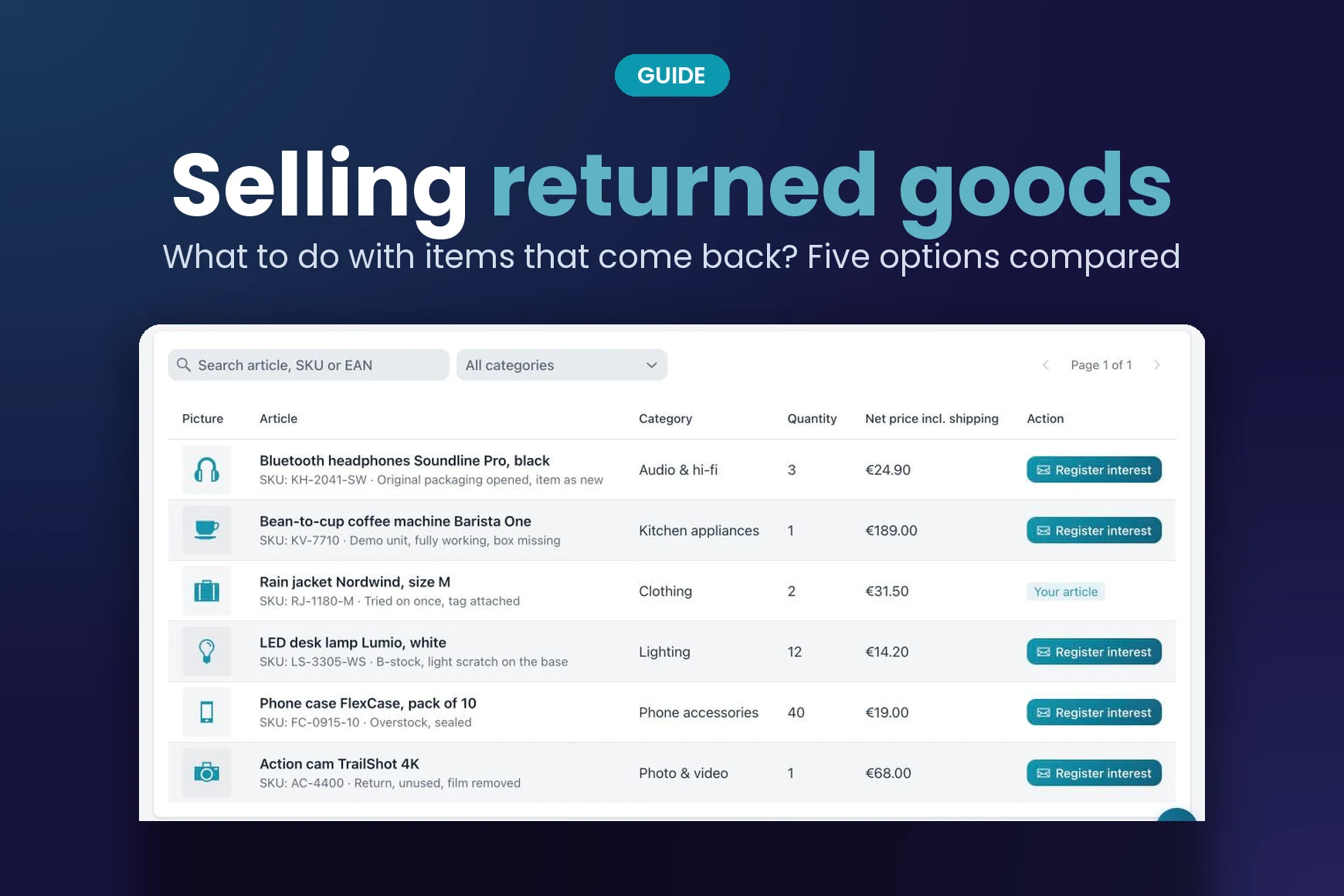
That is what the returns marketplace in Import2Shop is for. At the goods receipt of a return you choose the marketplace as destination, enter a net price including shipping, describe the condition and attach up to five pictures. The item is visible to other Import2Shop merchants straight away.

If a merchant is interested, they register that through the app. Our support puts you in touch, and the purchase then runs directly between you. With “List an item” you can also offer overstock and remainders that did not come from a return.

How does this fit into the returns process?

The right moment for the decision is the goods receipt. You have the item in your hand and see what condition it is in. In the Import2Shop returns portal you enter the quantity that arrived and its condition there and choose the destination per item.

That way no return is left without a decision. And the return only counts as completed once it is clear for every item where it goes.

Stop manual work – automate now!
Automate product imports, price calculation, and inventory in minutes instead of hours. Over 50,000 product updates daily – fully automated. More time for what really matters: your business.

Frequently asked questions

May I sell returned goods as new?

Only if they are unused and in perfect order. Opened or used goods should be offered as B-stock with a clear condition note. If in doubt, get legal advice.

Returned goods are everything that was sent back, whatever the condition. B-stock means items with opened packaging or small flaws, wherever they come from.

For example in the Import2Shop returns marketplace. There merchants offer returned goods, B-stock and remainders to other Import2Shop merchants.

In the returns marketplace you enter a net price including shipping. It is prefilled with your purchase price and you can change it freely.

They usually go back to the supplier. The return stays open until the supplier’s credit note has reached you.

Wholesaler integration: build or buy? What building it yourself really costs

Wholesaler integration: build it yourself or use software?

Connecting a wholesaler to your online shop: a custom build is quick to estimate and slow to pay off. What an integration really involves, what it costs compared with an AI subscription and your own time, where customer data ends up and when ready-made software is the better choice.

Read more
Pass returned goods on instead of storing them

The returns marketplace is included in every Import2Shop plan. See how you list returns right at goods receipt.

Benefits with Import2Shop
Table of contents
Live webinar · free

Integrations explained

See live how Import2Shop connects wholesalers, shops and marketplaces.