

If you want to connect a wholesaler to your online shop, developers and AI assistants often give you the same advice: the supplier has a CSV or an API, just write a script. For the first week, that is true. A wholesaler integration is not a script, though. It is a process that runs every day and has to be adjusted every time something changes on the supplier’s side. This article works out honestly what that means for you, what it costs by comparison, where your customer data ends up, and when building it yourself is still the right call.
- An integration works in two directions: product data into the shop, orders to the wholesaler. The second direction is usually forgotten in a custom build.
- Building it is the smallest part. On average, every wholesaler integration changes several times a year because the supplier changes files, fields or interfaces.
- An AI subscription that can actually build software costs 100 to 200 euros a month. Your own time comes on top, and that time is missing from sales.
- Order data is customer data. If you push it through an AI tool or a home-made script, you need a legal basis under data protection law.
- A custom build mainly pays off if your own development team takes care of maintenance. If you need your own processes, Import2Shop builds them as an individual customisation.
What does a wholesaler integration really involve?
Most estimates fail at the definition. “Import products” sounds like one task. In practice it is six:
- Fetching product data: CSV via FTP, an XML export, a JSON interface or a Shopify catalogue. Every wholesaler delivers differently, and many deliver several files that you first have to merge.
- Mapping data: Categories, variants, EANs, images, tax rates and shipping classes have to fit the fields of your shop system. What the supplier calls “colour” is an “attribute” in your shop.
- Calculating prices: The purchase price becomes a selling price with mark-up, rounding, minimum margin and a shipping cost share. Plus separate rules for marketplaces.
- Syncing stock: Several times a day, otherwise you sell goods the wholesaler no longer has.
- Transmitting orders: Every shop order has to reach the supplier, with the delivery address, in their format, and the tracking number has to come back to the shop.
- Handling errors: The file does not arrive, the file is empty, a column is missing, an EAN is duplicated. Someone has to notice before customers do.
If you only estimate the first point, you are off by a multiple.
What does a custom integration cost after launch?
The build can be planned. What comes after cannot. We run integrations with several dozen wholesalers ourselves and can see in our own change history how often a supplier changes something: on average we touch every integration several times a year, and every second one in the last twelve months alone. Not because it was badly built, but because things keep changing on the supplier’s side: new fields, changed categories, a new interface version, different image paths. With a custom build, every one of these changes would have needed a developer who happens to have time.
Then there are the costs that never appear in an estimate:
- The developer is gone. Freelancers move on, employees leave. The script keeps running until the first time it does not. Then nobody knows it.
- The shop system gets an update. A new shop version changes the interface, and the integration has to follow, usually under time pressure.
- The second wholesaler. With the first supplier you have one integration, with the third you have three that all behave differently. Two shops and three suppliers make six combinations.
- Nobody is watching. An import that fails silently at night only shows up when orders come in for sold-out goods. Nobody builds monitoring voluntarily.
AI subscription and your own time or ready-made software: which is cheaper?
The calculation “AI writes the script, it only costs me the subscription” has two gaps. The first: entry-level subscriptions for around 20 euros a month are fine for questions and short scripts, but not for building and maintaining an integration. For that you need the professional tiers of the common providers, and those cost 100 to 200 euros a month. The second gap is your time. Add the hours you spend writing prompts, hunting errors, re-reading the supplier’s file after a change and checking whether the order really arrived. If you count honestly, you end up with several hours a month, fewer in good months, considerably more after every change at the supplier. Value those hours at what an hour of selling or purchasing earns you, not at zero.
Import2Shop starts at 69 euros a month, all current plans are on the pricing page. That includes maintenance of all connected wholesalers and shop systems, order transmission and monitoring. The professional AI subscription alone already costs more, your own hours come on top, and they will not stay at two.
An import script is finished on the day it runs. An integration is finished on the day the wholesaler stops changing things. That day never comes.
Import2Shop Guide
What happens to customer data when an AI builds the integration?
The wholesaler’s product data is not sensitive. Orders are: your customers’ name, delivery address, email and phone number are personal data. As soon as a script transmits this data to the supplier, you are processing it, and the rules of the GDPR apply.
Three things happen in a custom build with AI that hardly anyone considers:
- Real data in the chat. If you give the AI an order file with real customer addresses for testing, you have transferred that data to a service outside the EU, often without a data processing agreement. With consumer subscriptions, inputs may also be used for training.
- Credentials in plain text. AI-generated scripts like to put passwords for FTP and supplier interfaces straight into the code. If the code sits with a hosting provider or in a repository, so do the passwords.
- No deletion. A script that buffers orders as files never deletes them. Two years later, thousands of delivery addresses sit in a folder nobody remembers.
We run Import2Shop as our own platform with hosting in the EU. Customers receive a data processing agreement, order data is only processed to transmit it to the supplier, and credentials are stored encrypted in the app. You can read how we handle data in detail in our privacy policy.
Custom build and ready-made software compared
Custom integration
Script or individual development
- Initial effort: Development time per supplier and shop system
- Ongoing maintenance: With every change by the supplier or shop
- Running costs: Professional AI subscription plus your own hours, every month
- Order transmission: Usually not included, added later
- Pricing rules: Hard-coded, changes need a developer
- Data protection: Entirely your responsibility, including AI tool and hosting
- Monitoring: Only if someone builds it
- Special requirements: Anything is possible, but you maintain all of it
- Fits if: Your own development team takes care of maintenance
Import2Shop
Ready-made integration as software
- Initial effort: Select supplier and shop, enter credentials
- Ongoing maintenance: We handle it for all connected wholesalers
- Running costs: Fixed monthly price, cancellable monthly
- Order transmission: Included, tracking numbers come back
- Pricing rules: Price templates, changeable without a developer
- Data protection: EU hosting, data processing agreement
- Monitoring: Imports and orders are logged
- Special requirements: As an individual customisation on request
- Fits if: You want to sell instead of maintaining interfaces
When is building it yourself still the right choice?
There are two cases in which we would recommend a custom build ourselves:
- You have your own development team that looks after the shop anyway and maintains the integration as part of its daily work. Then ongoing maintenance is not extra effort but routine.
- Your supplier is exotic. A single manufacturer with its own interface that nobody else uses. A script is the shortest route for that, as long as this one supplier is the only addition.
Your own pricing logic, special rules for range or delivery times and processes that only exist at your company are not a reason to build it yourself. We develop such requirements as an individual customisation, on the same platform we run anyway. You get your own logic without having to maintain your own integration. Find out more under custom software development.
If neither case applies, a custom build means paying for something that already exists, and paying again every month in developer hours.
How does Import2Shop handle the wholesaler integration?
Import2Shop is software that takes over exactly these six tasks for you. You choose your wholesaler and your shop system, enter the credentials and set pricing rules. The automatic data import does the rest: products, variants, images and stock land in your shop and are kept up to date.
Orders go to the supplier through automatic order processing, and tracking numbers come back. Selling prices come from the price calculation with mark-ups, rounding and minimum margins that you can change at any time without a developer.
Shopware, WooCommerce, Gambio and Shopify are among the connected shop systems, along with marketplaces such as eBay. The interfaces page lists all supported shop systems and wholesalers. If your supplier is missing, we check whether we can connect it. When something changes at a wholesaler, we adjust the integration, for all customers at once.
- Hours of manual CSV imports
- Calculate and adjust prices manually
- Check and update inventory manually
- Forward orders to wholesalers individually
- Maintain product images and descriptions manually
- Fully automatic data imports
- Intelligent price calculation in real-time
- Automatic inventory monitoring
- Automated order processing
- Synchronous updates without effort
Frequently asked questions
How do I connect a wholesaler to my online shop?
Either with a custom development that reads product data and transmits orders, or with software like Import2Shop that already knows the wholesaler and the shop system. In the second case you only enter credentials and pricing rules.
Is a CSV import script enough for dropshipping?
For the first import, yes. For ongoing operation it lacks stock sync, order transmission, pricing rules and error handling. Those are exactly the parts that take the most effort.
What does a custom interface to a wholesaler cost?
Building it is the smaller part. The running costs arise with every change on the supplier or shop side and need a developer every time. A serious estimate therefore counts ongoing hours per month, not a fixed price.
Is an AI subscription cheaper than dropshipping software?
No. The 20-euro subscriptions are not enough to build an integration, the professional tiers cost 100 to 200 euros a month. Add your own hours for building, debugging and maintenance after every supplier change. Import2Shop starts at 69 euros a month, maintenance included.
Can an AI program the wholesaler integration for me?
An AI can write an import script. It does not maintain it when the wholesaler changes the file, and it does not check whether the import ran overnight. Maintenance stays with you.
May I put my customers' order data into an AI tool?
Only with a legal basis and a data processing agreement with the provider. Consumer subscriptions of AI services usually lack both, and the data leaves the EU. For testing, only invented sample data belongs in the chat.
Which wholesalers can I connect with Import2Shop?
Several dozen, including InnoCigs, BigBuy, Kosatec, Nedis and vidaXL. The current list is on the interfaces page. If a supplier is missing, we check the integration on request.
Can Import2Shop be adapted to my own processes?
Yes. We develop your own pricing logic, special rules for range or delivery times and additional interfaces as an individual customisation. They run on the same platform as the rest of your integration.
What happens to my data if I cancel Import2Shop?
The products stay in your shop, they belong to you. Only the ongoing updates and the order transmission end.
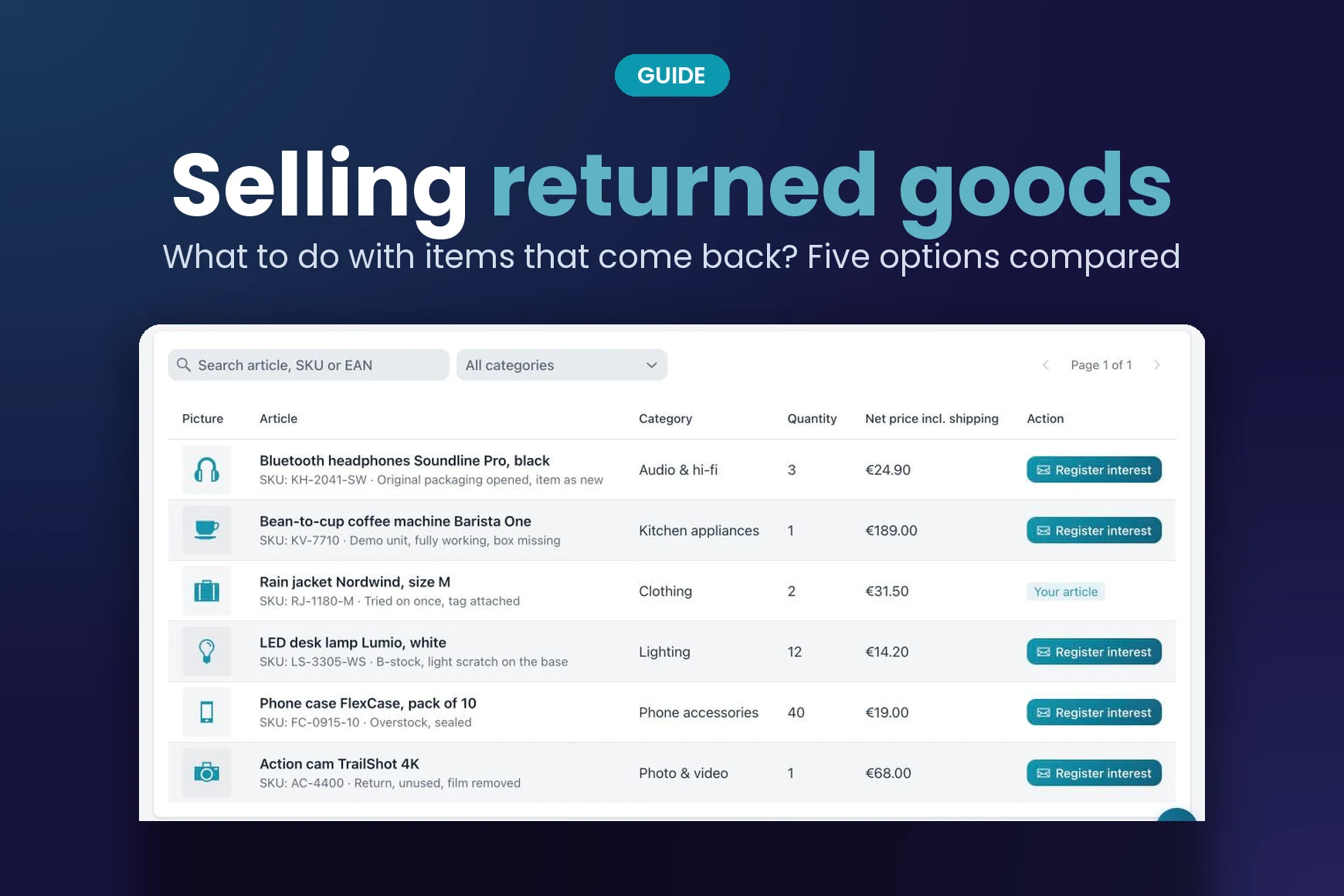
Selling Returned Goods: What to Do with Items That Come Back
Selling returned goods instead of storing them: five options for items that come back, what matters about the condition and how merchants pass returns on to each other.
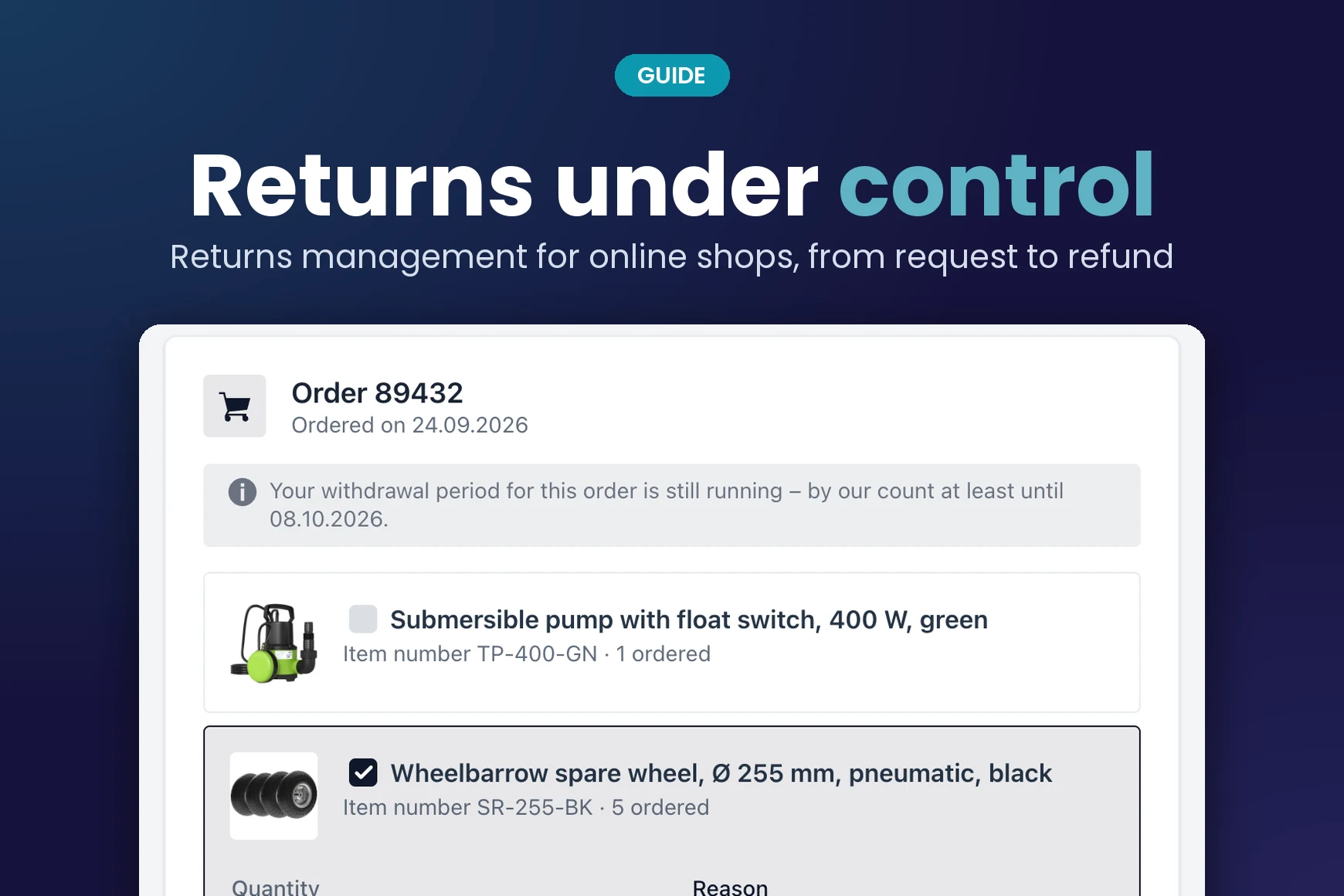
Returns Management for Online Shops: How to Keep Returns Under Control
Returns management for online shops: the five steps of a return, common mistakes with periods and return shipping, and how a returns portal brings order to the process.
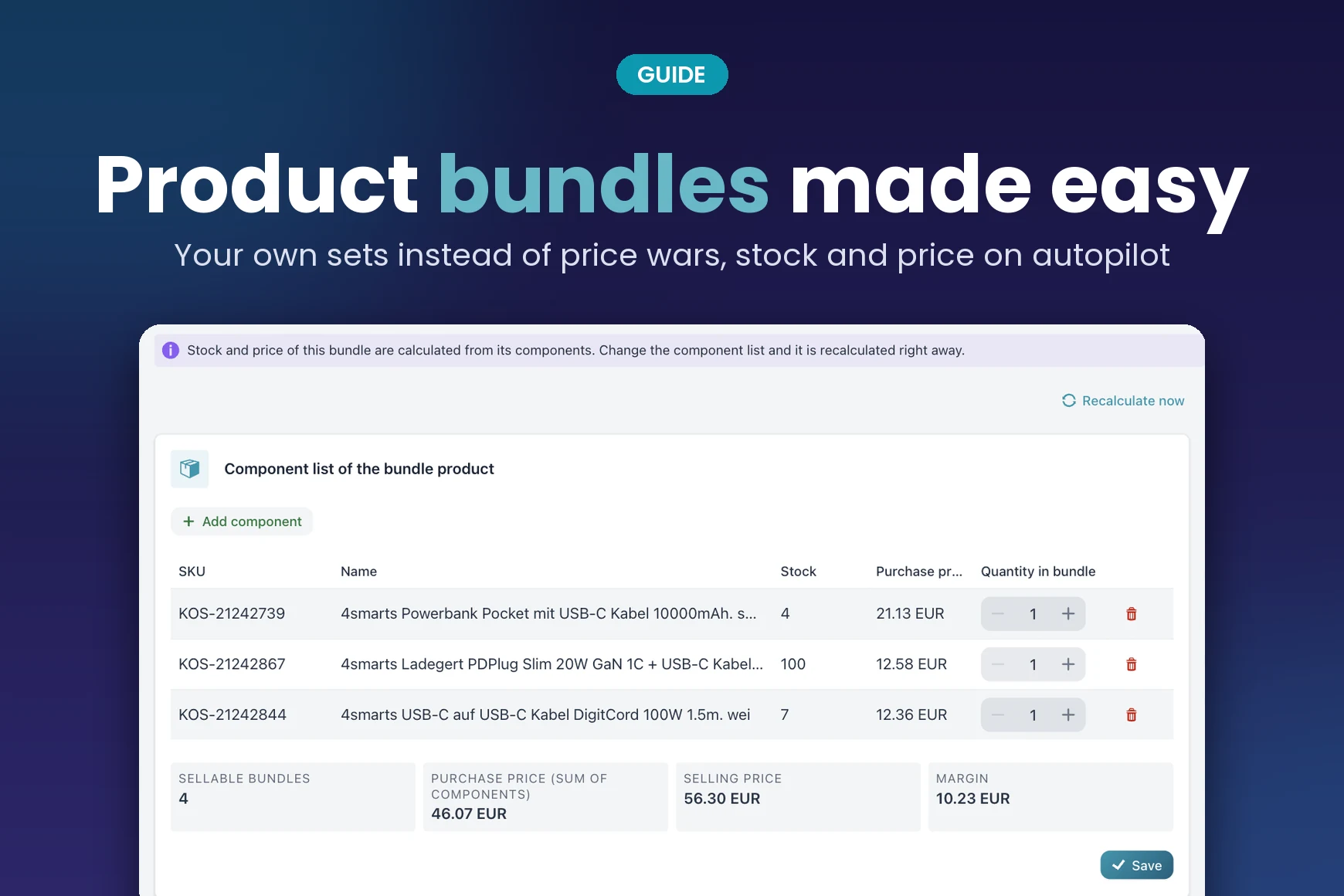
Create Product Bundles: Stand Out with Your Own Sets
Create product bundles and step out of the price war over identical listings: bundle types, common pitfalls with stock and margin, and how to keep sets clean in your online shop.
See which wholesalers and shop systems Import2Shop already connects. If yours is missing, let us know.


